
The historical heritage of the town of Sutri, located about 50 km north of Rome, is as rich as it is unexplored by both local and foreign travelers. Today Sutri is one of the most picturesque towns near Rome located along the Via Cassia, an ancient Roman consular road, built in the 3rd century BC as a link with Etruria, the land inhabited by the Etruscans.
In recent years Sutri has focused on the development of cultural, artistic, and tourist offer, obtaining the mention of Orange Flag by the Italian Touring Club and of one of the “Most Beautiful Towns of Italy” by the homonymous association. This represents an incentive to add the town to your Italy itinerary. Sutri is very accessible to visit on a day trip from Rome, but do consider spending at least one night there in order to see as much as you can in and around Sutri, Italy.
Here are the most delightful things to see and do in Sutri Italy
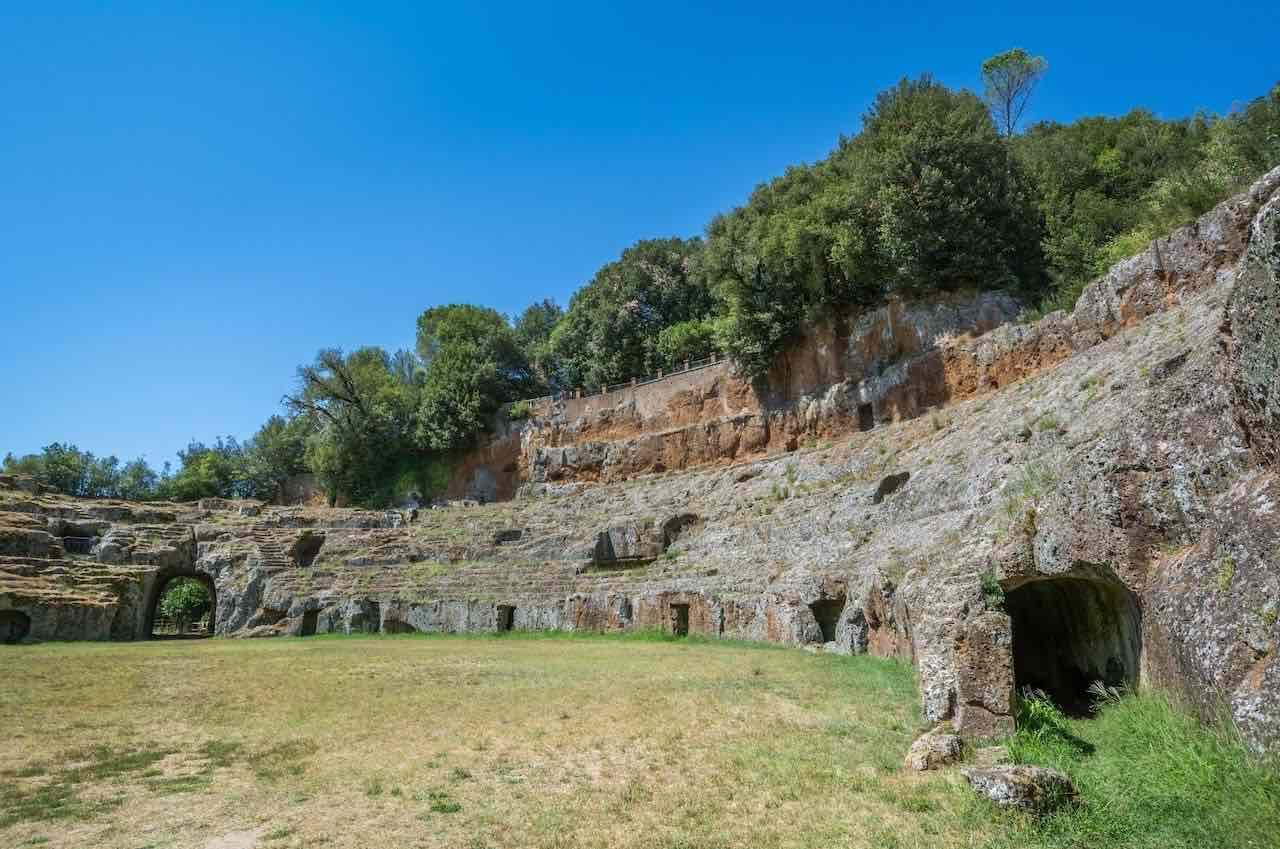
THE ROMAN AMPHITHEATER
The most spectacular historical landmark in Sutri is the amphitheater located just outside town, built in Roman times between the 1st century BC and the 1st century AD. The peculiarity of this site is that the amphitheater was not actually “built”, but excavated inside a hill of tufa rock. There are only two other amphitheaters of this type in the world, one is in Sardinia and the other in Libya.
The amphitheater of Sutri fits perfectly into the landscape and it is difficult to see it from the outside, even if it is located along the Via Cassia, just before the little climb that leads to the historic center of Sutri.
Entering through an imposing arch into the environment of the amphitheater, in whose arena a soft lawn has grown, one breathes an atmosphere of tranquility and majesty.
The amphitheater of Sutri could hold about 7000 people, who sat according to their social class on one of the three tiers of seats. A tunnel with several openings on the arena runs all around the circumference of the amphitheater, which has an elliptical shape.
The decorations and statues that surely must have been present in antiquity have been lost.
To get a view of the Roman amphitheater from above, take the path along Via Cassia that leads to Villa Savorelli until you reach a terrace that will be just right for this purpose.
The amphitheater of Sutri is part of the “Parco Naturale Regionale Antichissima Città di Sutri“. To enter, you have to buy an €8 ticket, which also allows you to visit other interesting monuments in the park that we will see in a moment.
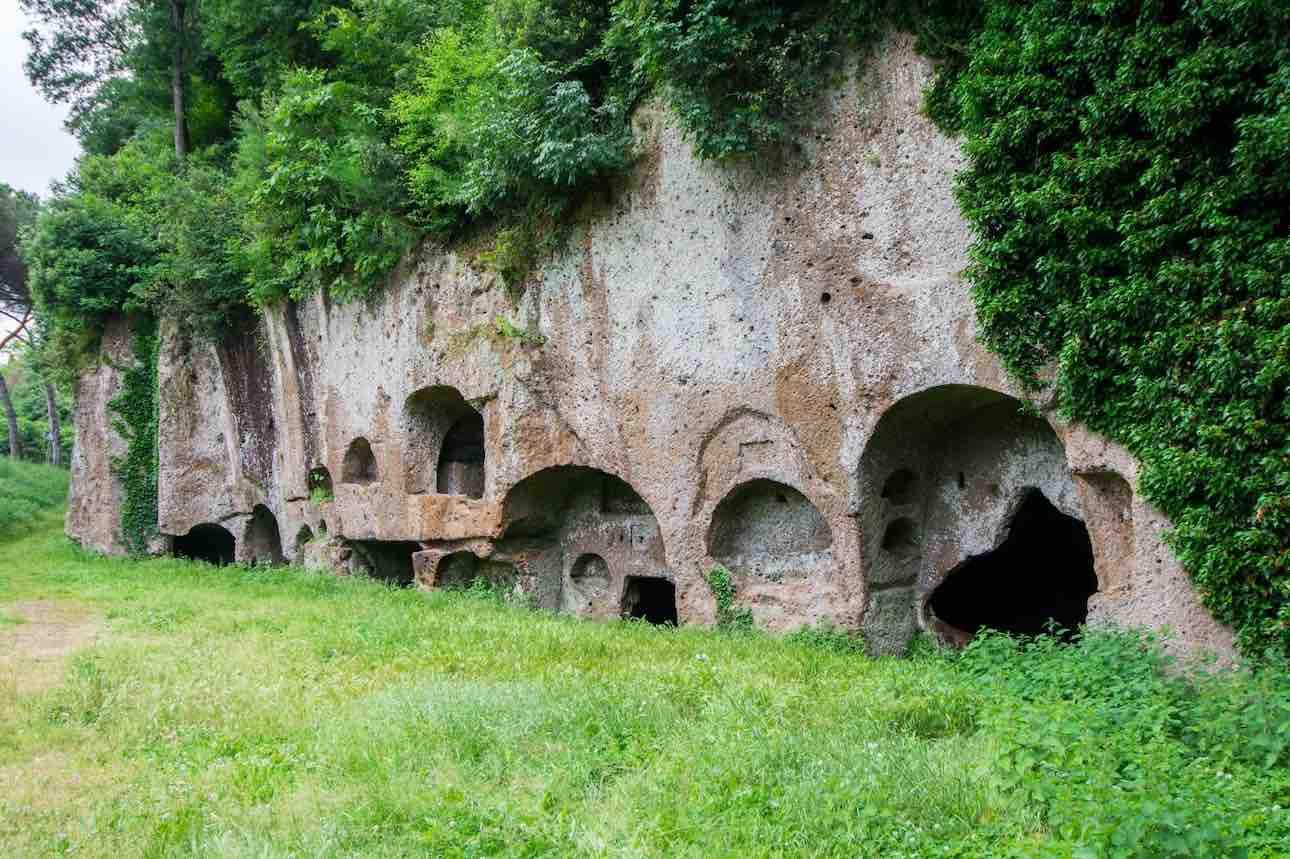
THE ETRUSCAN NECROPOLIS
The fascinating rocky necropolis that develops along a wall of tufa rock that can be seen very well even from the Via Cassia is just one of the Etruscan necropolises in the area surrounding Sutri. It develops before and after the amphitheater and includes 64 chamber tombs of different workmanship created between the 1st century BC and the 4th century AD and then have undergone interventions in subsequent eras.
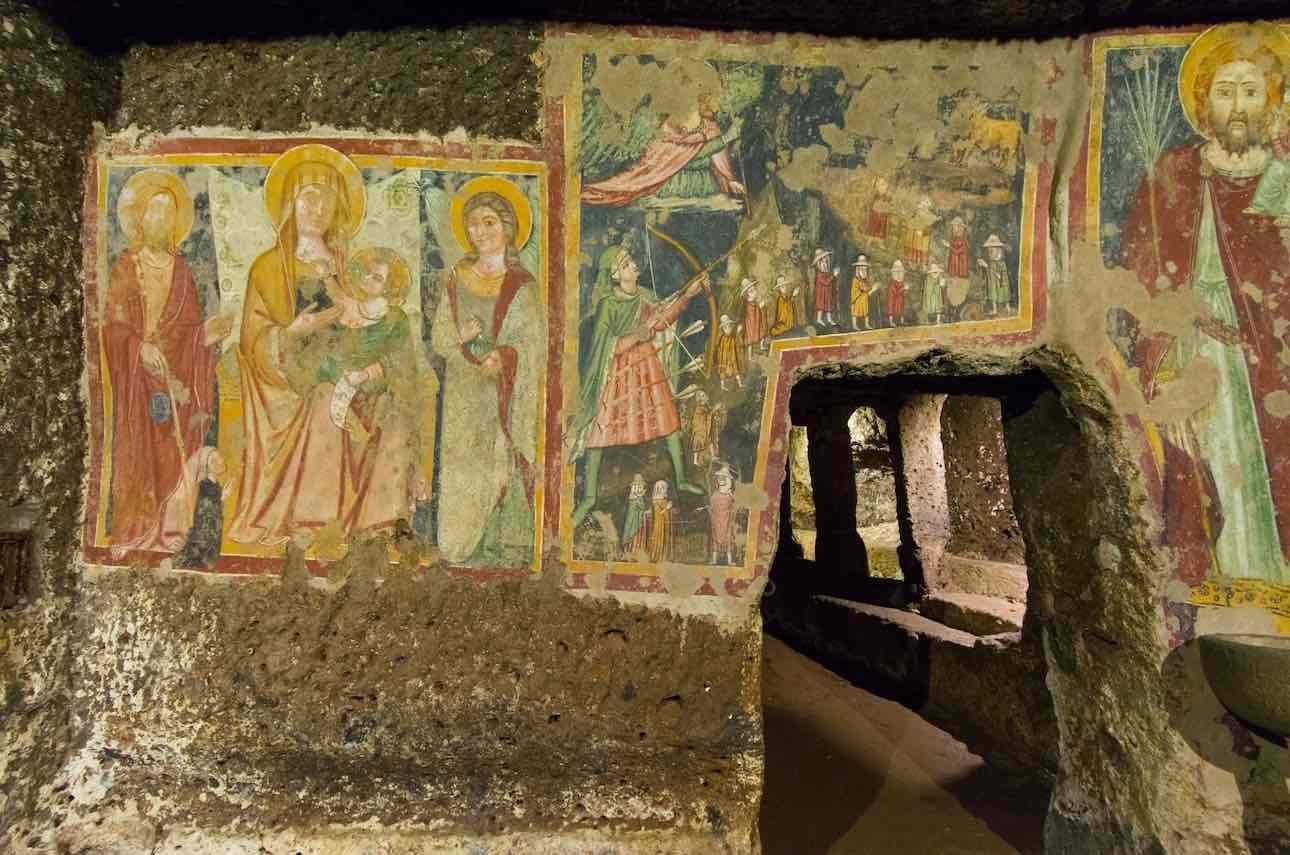
THE MITHRAEUM OF SUTRI
The “Parco Naturale Regionale Antichissima Città di Sutri” also hosts the Church of the Lady of Birth, a hypogeal church that develops entirely inside the rock. The church, with its 13th and 14th-century frescoes, is an adaptation of a 3rd century A.D. Mithraeum, which was built on an Etruscan burial site. The cult of Mithras, which originated in central Asia, had spread in the Roman Empire through the conversion of soldiers and was supplanted by Christianity.
The temple was first consecrated to St. Michael the Archangel and then to the cult of the Virgin Mary.
In order to enter the rock church, you have to get the door opened by one of the employees of the management of the archaeological area, with whom you can get in touch through the ticket office near the Roman amphitheater. The ticket is the same for the amphitheater and the Mithraeum and comes with a map and a handy audio guide in English.
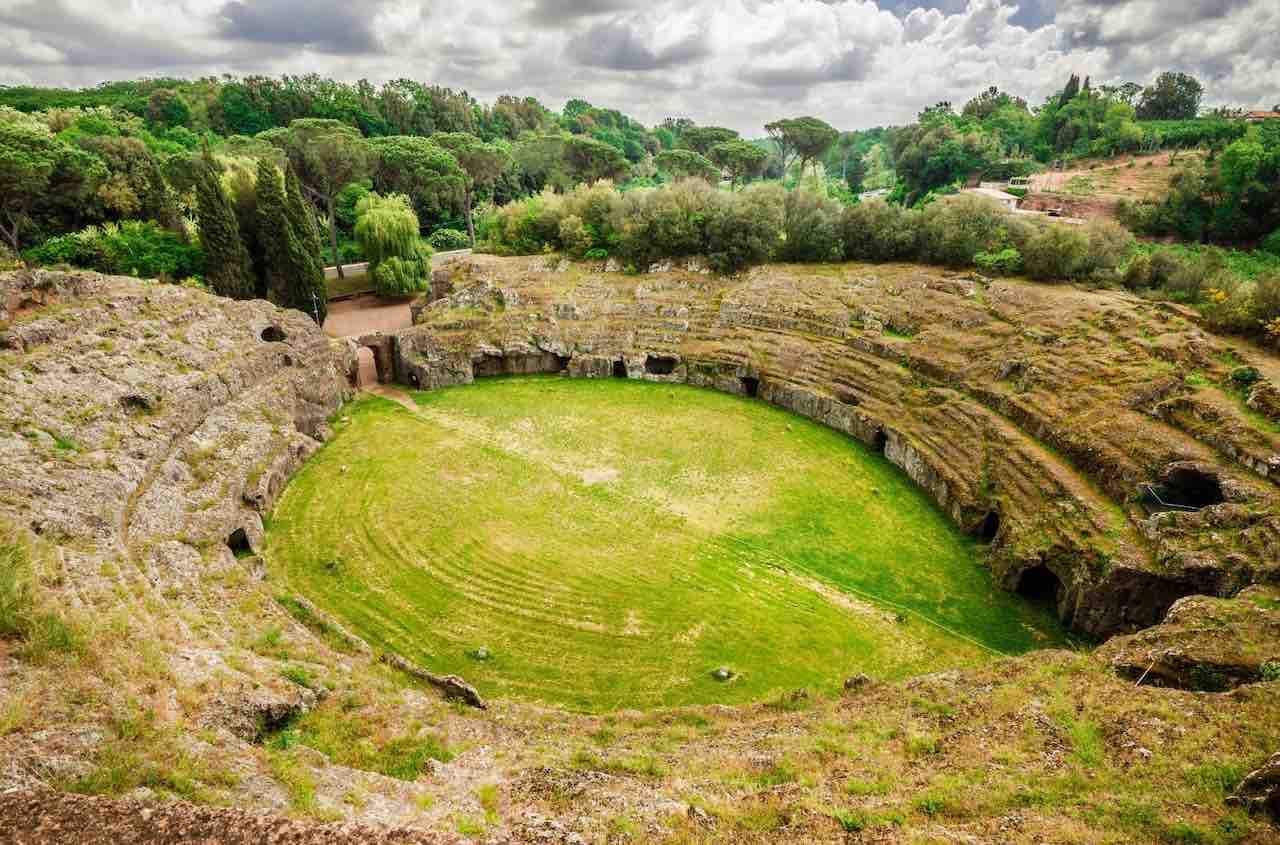
VILLA SAVORELLI
Walking along the path that climbs from the ancient Mithraeum to the top of the hill overlooking the Roman amphitheater and the entire archaeological park, you will encounter other buildings of historical and artistic value.
Villa Savorelli is a Renaissance residence built in the 15th century and then renovated over the centuries and especially after the bombings of World War II. Today the villa hosts events and ceremonies and is the seat of the regional natural park.
To complete the building there is an Italian garden and a wood of secular holm oaks that over time has earned the name of “sacred wood“.
In front of the villa stands the Church of the Lady of the Mountain, a medieval church of the 13th century that underwent several changes in the 18th century.
THE PIAZZA DEL COMUNE
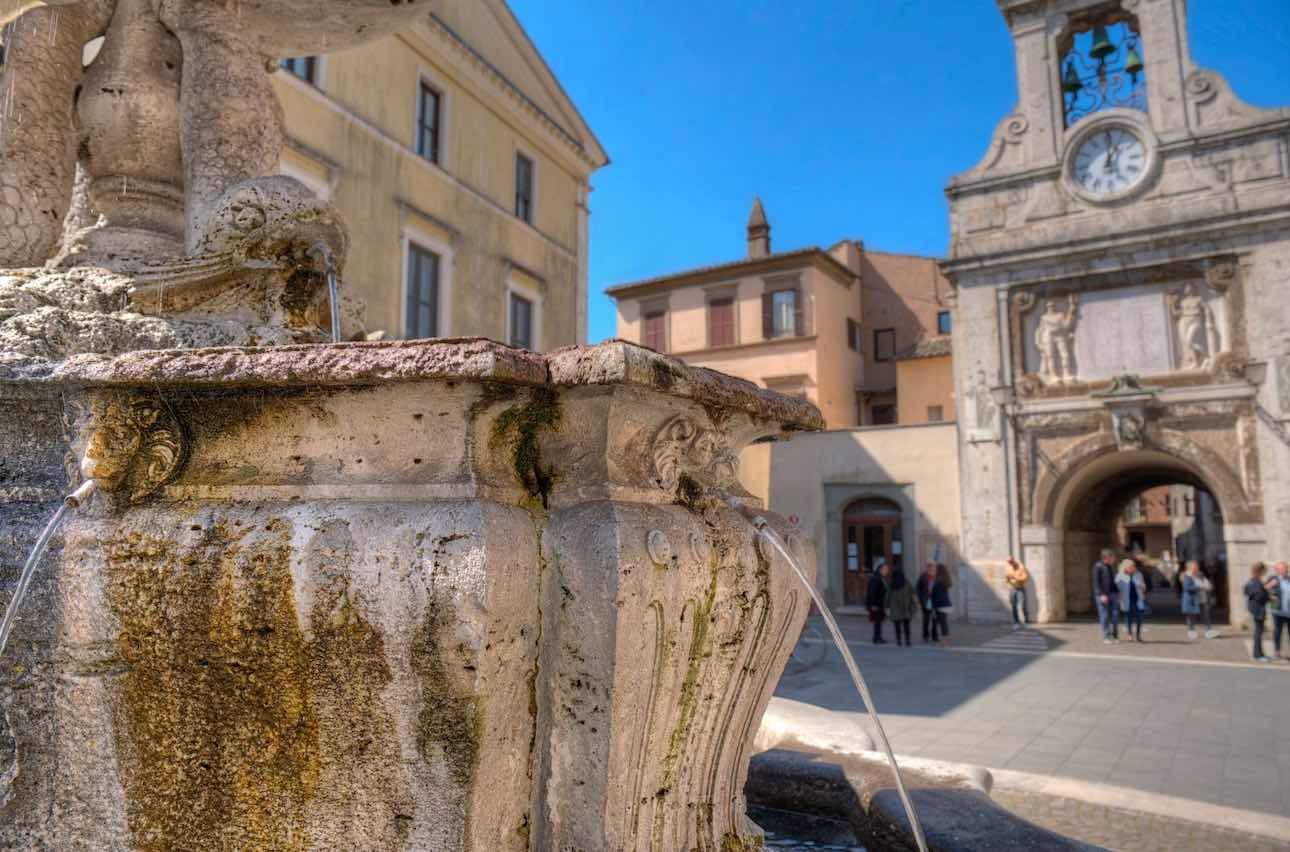
The heart of the historical center of Sutri rises on the ruins of the ancient Roman forum of the city. Here is the palace that houses the municipality and the marble bell tower, still in operation. In the center of the piazza, the water that flows from the fountain with 4 basins gently accompanies those who have sat at the tables of the cafes to have a drink.
DOEBBING PALACE
Episcopal seat since the Middle Ages, the Palace was dedicated by the current mayor of Sutri Vittorio Sgarbi to Father Joseph Bernard Doebbing, bishop of Nepi and Sutri from 1855 to 1916 and an active promoter of education of the people.
In the last twenty years, the building has received a thorough renovation that has made it ideal to be used as an exhibition space for contemporary art on an area of about 1000 square meters.
In addition to visiting this ancient palace you can then enjoy the exhibitions, the ticket costs €10 but you can also buy for €15 the ticket for Palazzo Doebbing plus the archaeological area with the amphitheater, the Mithraeum and Villa Savorelli.
CURIOSITIES ABOUT SUTRI
Sutri is also nicknamed the “antichissima” or the “very ancient town”. A legend that tells the mythical foundation of the city says that it was founded by the god Saturn himself (from Saturn comes the name Sutri). The coat of arms of the city represents Saturn on a horse bearing ears of corn as a sign of abundance.
WHERE TO EAT IN SUTRI
The best place to eat in town is definitely the Cantina del Drago. In an elegant location surrounded by a lawn 5 minute walk from the historic center, you will find a menu full of excellent dishes for all tastes at affordable prices. One of the most popular dishes is the tagliolini alla caprese gialla. The dishes are presented in a refined way and the choice on the wine list is wide. We suggest reserving if you want to find a table.
ACCOMMODATION IN SUTRI ITALY
As for the other small villages of the Tuscia region, also in Sutri, there are different categories of accommodations, it is only a matter of choosing the one that suits you.
If you move by car, consider staying at Antico Borgo di Sutri, a comfortable hotel surrounded by the countryside, 5 km from the historic center.
If, on the other hand, you prefer to stay a short walk from the center of town, near the square and the restaurants, check out the Casetta di Carlo Magno B&B.
WHERE TO GO AFTER SUTRI
After visiting the town you will want to discover other destinations off the beaten path nearby. Then proceed by stopping in Calcata, the village rebuilt by artists and hippies in the 60s and then in Nepi, the “city of water”. Absolutely not to be missed is also Lake Bracciano and the towns that overlook it: Anguillara Sabazia, Trevignano Romano and Bracciano with its famous castle.
If you love contemporary art, visit Opera Bosco, Museum of Art in Nature, featuring a path of 45 installations inside a lush forest.
If you’re traveling in central Italy, read on:
5 Fantastic Day Hikes near Rome
The 10 Most Beautiful Lakes near Rome
How to Visit Tuscany from Rome
Let me know in the comments any questions you might have about visiting Sutri Italy!