
Here you will find a very useful local guide to spending an exciting weekend in Rome while being able to see all the most interesting sites in the city of my birth. If you have decided to visit the city in 48 hours, it is essential to plan well your itinerary for 2 days in Rome, so you can both admire the most spectacular monuments and views and spend the evening in some picturesque neighborhood. Rome’s historic center is very large and dense with landmarks. Be prepared to move between sites on foot, and instead return to your hotel by public transportation or cab.
I’ll tell you the distances you’ll cover by walking and where to stop for coffee or ice cream. I’ll also give a helpful historical introduction to all the monuments you’ll see.
At the end of the article, I will also give you some advice on facilities and places to stay. Since your time in Rome is limited, I will suggest you stay in the historical center and possibly near the Colosseum…
Let’s start this strategic 2 days in Rome itinerary!
DAY 1 – 2 DAYS IN ROME ITINERARY
On the first day, we walk about 3.5 km. The first stop is the Colosseum. You stop for lunch or a snack halfway between the Colosseum and the Pantheon, which is the last stop before heading to the place where you dine. Then it’s back to the starting point or to the hotel by transport (or a cab or on foot if you prefer!).
Leg 1: Colosseum
Since you’ll only be in Rome for 48 hours, it’s best to start your itinerary through the beauties of the historic center from the most famous Roman monument in the world, which will immediately catapult you into the ancient atmosphere of the city.
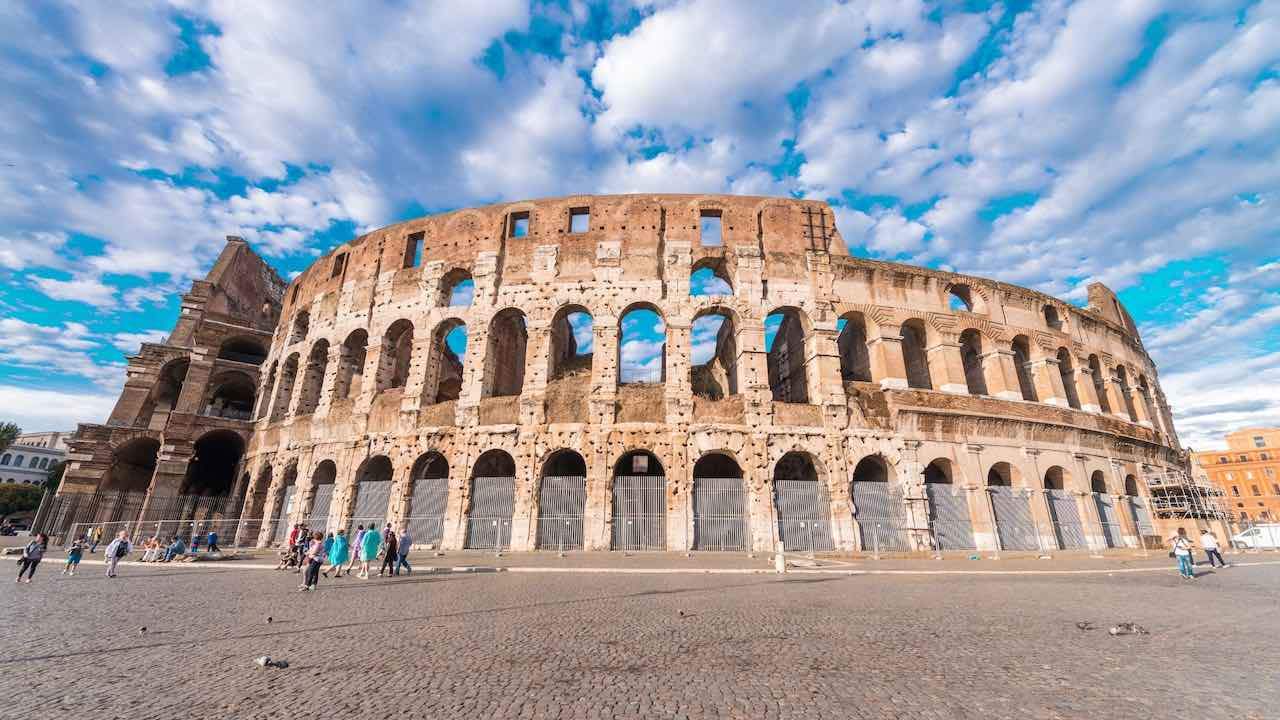
The visual impact with the Colosseum is impressive. With your head turned upwards, to embrace with your eyes the four orders that stand on the elliptical plan, walk the entire outer perimeter. Then climb the marble stairs that take you from Piazza del Colosseo to Via Nicola Salvi to take a romantic photo with one of the best profiles of the monument.
The Colosseum was built on the orders of Titus Flavius Vespasian, who ascended to the throne after Nero’s deposition, to consolidate the consensus of the people and celebrate the founding of the Flavian dynasty.
At the shows inside the Colosseum, anyone could assist freely, from the senators to the plebs. The Colosseum was completed in 80 AD. On the occasion of the inauguration, there were games in which more than 5000 beasts were slaughtered.
To learn more about the architecture of the Colosseum and how the fights between gladiators and animals that took place inside worked, read my article on Questions and Answers about the Colosseum.
The ticket to visit the inside of the Colosseum is inclusive of the ticket for the Roman Forum and the Palatine Hill and must be booked in advance on the COOPCULTURE – COLOSSEO website.
Leg 2: Roman Forum
Opposite the Colosseum, you will find one of the entrances to the area full of ancient buildings and ruins called “Roman Forum“. This is the oldest part of Rome where the legends about the founding of Rome are set, such as the story of Romulus and Remus and the Rape of the Sabine Women.
In the Roman Forum is the Palatine Hill where it is said that Romulus and Remus were raised by the she-wolf and where Romulus, once eliminated his brother, drew the city borders.
Emperor Augustus (27 B.C.-14 A.D.) and his successors settled on the Palatine Hill. Here you can admire the Villa of Augustus and the Villa of Empress Livia, his wife. Moreover, there is the Orti Farnesiani, the first botanical garden in the world, wanted in the middle of the 16th century by the exponents of the powerful Farnese family.
Even today, some areas within the Roman Forum are the subject of archaeological excavations.
At one time, even before the reign of Romulus, the forum was a marshy area where the dead were buried and where boats could float. The forum then represented the border between the territory of the Latins and Sabines and only after the peace between the two tribes and the subsequent declaration of the kingdom the area was paved and became the place of the public and political life of Rome. The Roman forum also housed the temples and altars to the many Roman gods, stores, and ancient banks.
Given the size of the archaeological site and the complexity of the history of the buildings built in different eras (from prehistoric times to the Renaissance), I recommend that if you decide to take a walk inside the Roman Forum, you take a guided tour.
The tour “ROME: COLOSSEUM AND ARENA GUIDED TOUR” will get you skip-the-line tickets and guide you through the Colosseum (including the underground), the Roman Forum, and the Palatine Hill.
Leg 3: Via Dei Fori Imperiali
Perhaps the most scenic street in Rome, it connects the Piazza del Colosseo to Piazza Venezia. It is an elevated street that crosses the Forums, on the border between the Roman Forum and the Imperial Forums. The road was designed and built in the 30s of the twentieth century and cost the cancellation of tens of thousands of square meters of ancient buildings.
Walking along it you can admire the forums from a privileged position.
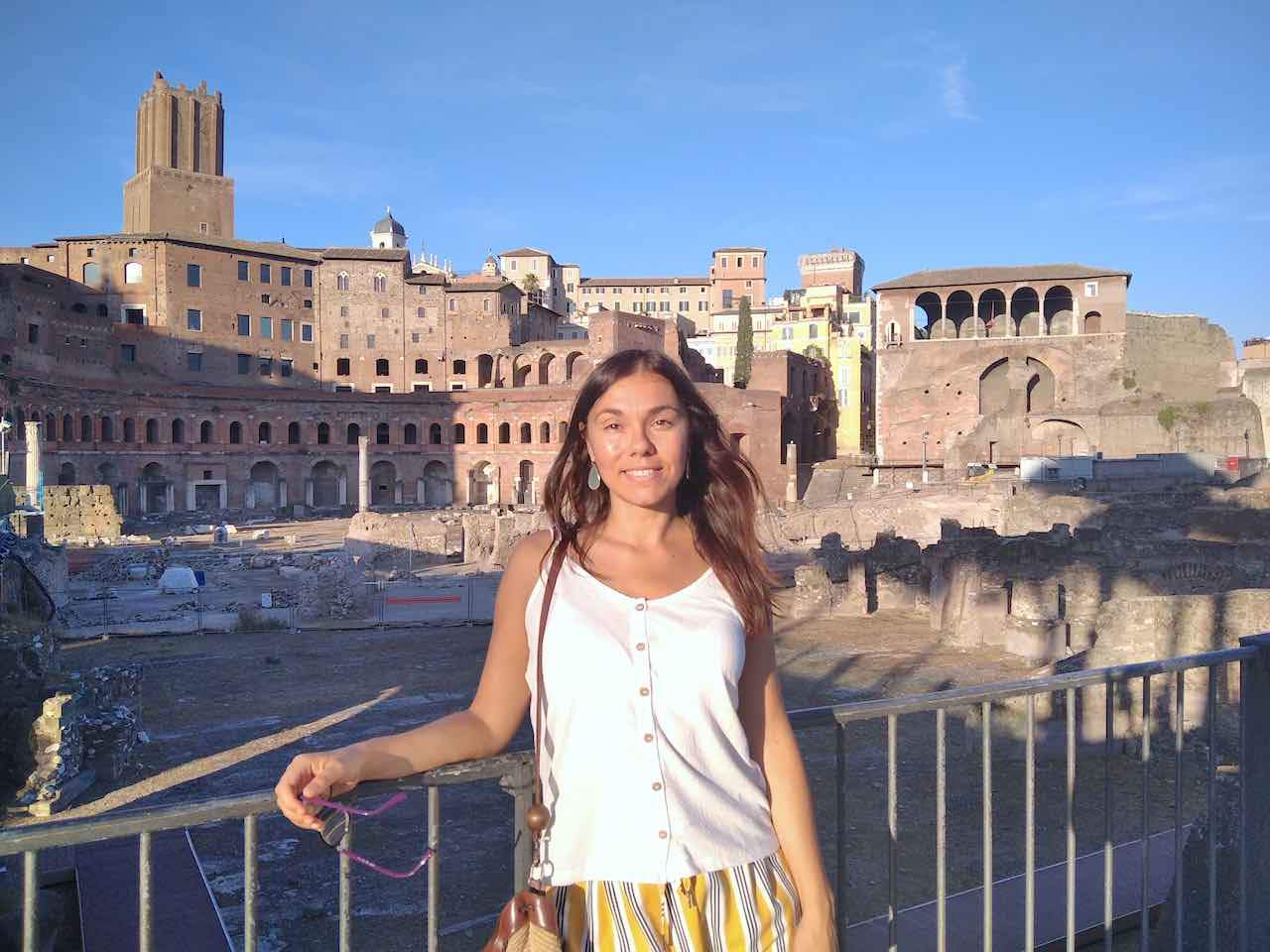
Leg 4: Imperial Forum
At the time of Caesar, when Rome became an empire, an extension of the Roman Forum was necessary. Caesar bought the land next to the Roman Forum with the spoils of war in 54 BC and began to construct buildings there. Successive emperors, Augustus, Nerva, and Trajan, made changes and additions. Today the best-preserved forum is that of Trajan, with its buildings known as the “Markets of Trajan“, where exhibitions of ancient and contemporary art are held. In one part of the forum stands the Trajan Column, at the base of which Trajan and his wife are buried. The bas-reliefs on the column tell the story of the war against the Dacians.
If you have visited the Roman Forum, perhaps it would be wise to give up visiting the Imperial Forums as well. Since you’ll only be in Rome for two days, better to dedicate time to other monuments.
You can always stop and enjoy the view of the Imperial Forums from Via dei Fori Imperiali.
Leg 5: Piazza Venezia
When you get to Piazza Venezia, you’ll feel like you’ve already seen so much of Rome, but we’re still not even halfway through the itinerary of the first day… But don’t worry, we’ll be taking a break soon!
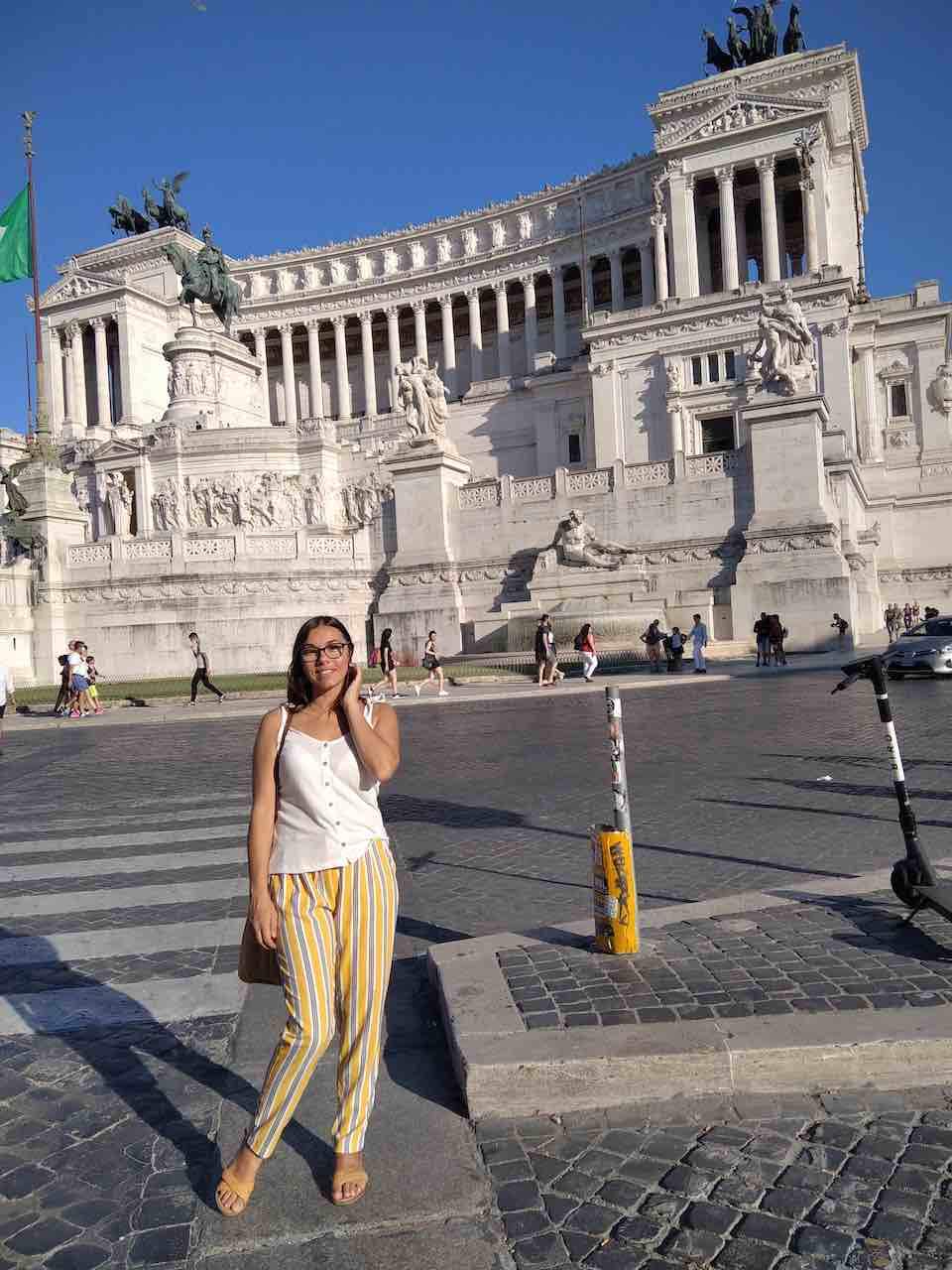
There are so many buildings that overlook the square, from which Via del Corso also branches off, one of the best shopping streets in Rome, which we will visit on the second day of this 2-day itinerary in Rome. The entire square was renovated between the late 19th and early 20th centuries, two entire ancient quarters demolished, to make way for the construction of Via dei Fori Imperiali and the monument to Victor Emmanuel II, the first king of united Italy.
Also known as the “Vittoriano,” the massive neoclassical building was repurposed as the “Altar of the Fatherland” in 1921 after hosting the burial of the Unknown Soldier. From the main staircase of the Altar of the Fatherland as well as from the side streets you can access the elevators that lead to the terrace at the top of the monument, where you will enjoy a 360° panoramic view of Rome (€12).
Leg 6: Capitoline Hill
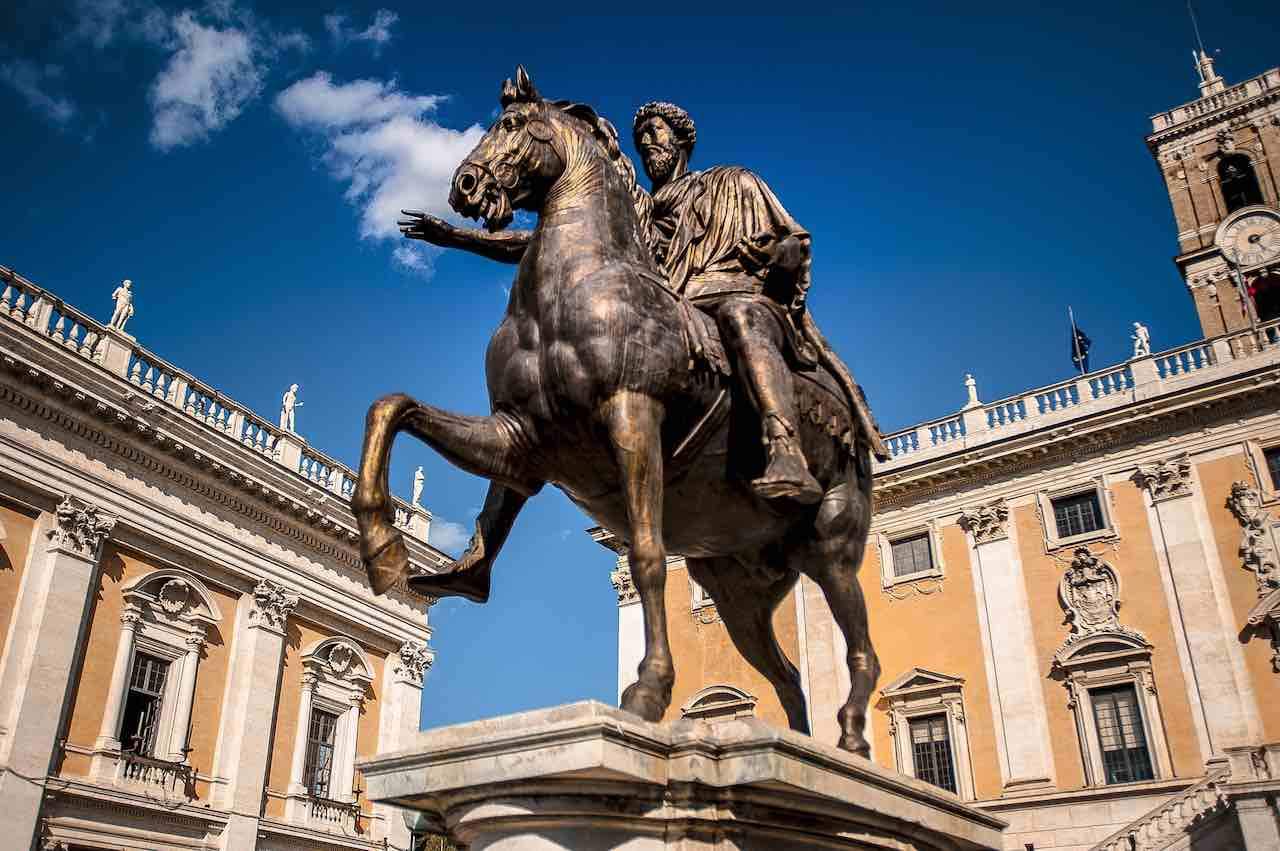
After admiring the rooftops of Rome, head straight to one of Rome’s 7 hills, where you’ll still breathe in some of the histories of ancient Rome. The Capitolium was the hill where the most important sanctuaries of ancient Rome were located. The hill has two peaks with a depression in the center, where in the 16th century Michelangelo Buonarruoti realized the Piazza del Campidoglio on which we still walk today, with the bronze statue of Marcus Aurelius on horseback in the center (2nd century AD).
At the time of the Romans, the temple to Juno Admonisher and the imperial mint were located on the northern summit of the Capitoline Hill, while in medieval times the Church of Santa Maria in Ara Coeli was built there. The southern summit was once occupied by the Temple of Jupiter. Walking around the small Piazza del Campidoglio, you will find:
- a corner that offers a fascinating view of the Roman Forum.
- access to the Capitoline Museums
- access on one side of Villa Caffarelli that leads to the Caffarelli Terrace.
At the Caffarelli Terrace, there is a café where you can rest a bit and enjoy one of the most beautiful views of Rome.
At this point you have deserved a restorative lunch or at least a substantial snack, let’s see where you can go to satisfy this primary need always following this itinerary to see Rome in 2 days!
Time for lunch: 2 options for day 1 of your 2 days in Rome itinerary
Would you like to sit down and have lunch or a portion of hearty street food? In case you want to sit down, take a bus for 3 stops (or walk) from Largo Argentina (bus nr. 62, 64 or 916) and get off at Corso Vittoria Emanuele/ S. A Della Valle. You will then reach Osteria da Fortunata on Via del Pellegrino 11. This is one of the best trattorias in Rome and offers all the Roman dishes, but the specialty is the pasta, which is all homemade: carbonara, gricia, cacio e pepe, gnocchi… Phone reservations are absolutely recommended.
If you want a faster and cheaper meal based on the most popular street food in Rome, that is pizza by the slice or “pizza al taglio“, getting off at the same stop you can go to Alice Pizza.
Leg 7: Piazza Navona
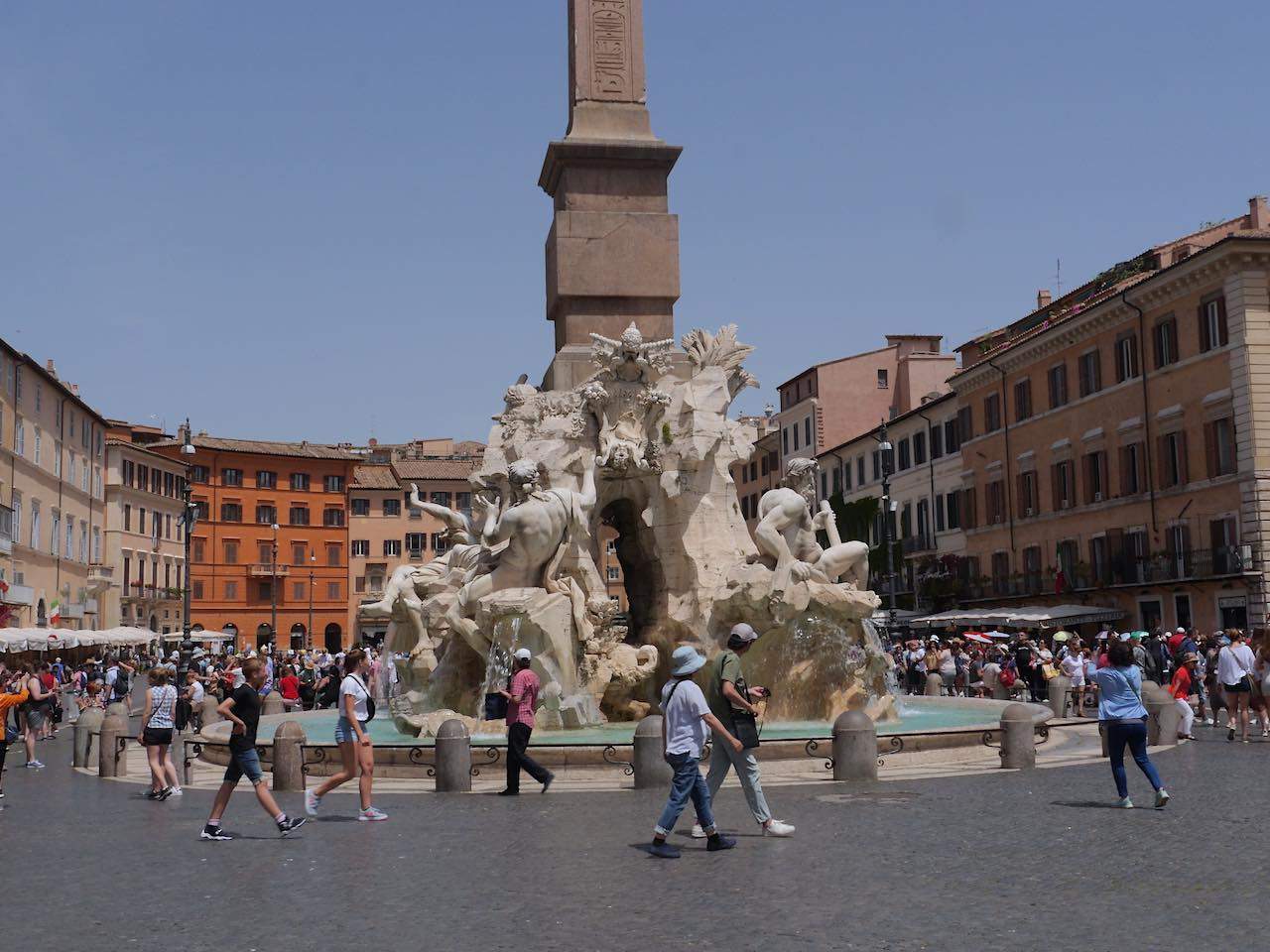
And now reach one of the most beautiful squares in the world, Piazza Navona. The current arrangement of the square dates back to the Baroque era (17th century). The peculiarity of this place is the elongated plan, in fact, in Roman times, in the first century AD here stood the Stadium of Domitian, where the Greek athletic games were held. The current level of the square is 6 meters higher than that of the stadium.
In the 15th century the market for food products, which until then had been held in Piazza dell’Ara Coeli, was transferred to the Navona square. During the Renaissance (16C), Pope Gregory 13 installed three fountains in the square to facilitate market activities. The works for the great rearrangement of the piazza began in 1630, when the future pope Innocent 10 of the Pamphili family had Palazzo Pamphili built and later commissioned Bernini to design the Fountain of the Four Rivers, in the center of the piazza with the obelisk. The two lateral fountains, the Fountain of the Moor and the Fountain of Neptune,date back to the 16th century.
On one of the long sides of the square stands the majestic Church of St. Agnes, which is said to have been built on the site where the Christian saint was martyred. The architects of the Baroque church were Girolamo and Carlo Rainaldi and the Borromini, commissioned by Pope Innocent the 10th who is buried there.
The square often hosts street performers and from December 8 to January 6 the city’s most famous Christmas market.
If you want to stop and look at the amazing sculptures and the goings-on, do it while holding gelato or a granita of the Grom Gelateria, at the corner with Via Agonale, made without the use of additives.
Leg 8: Pantheon, Piazza della Rotonda
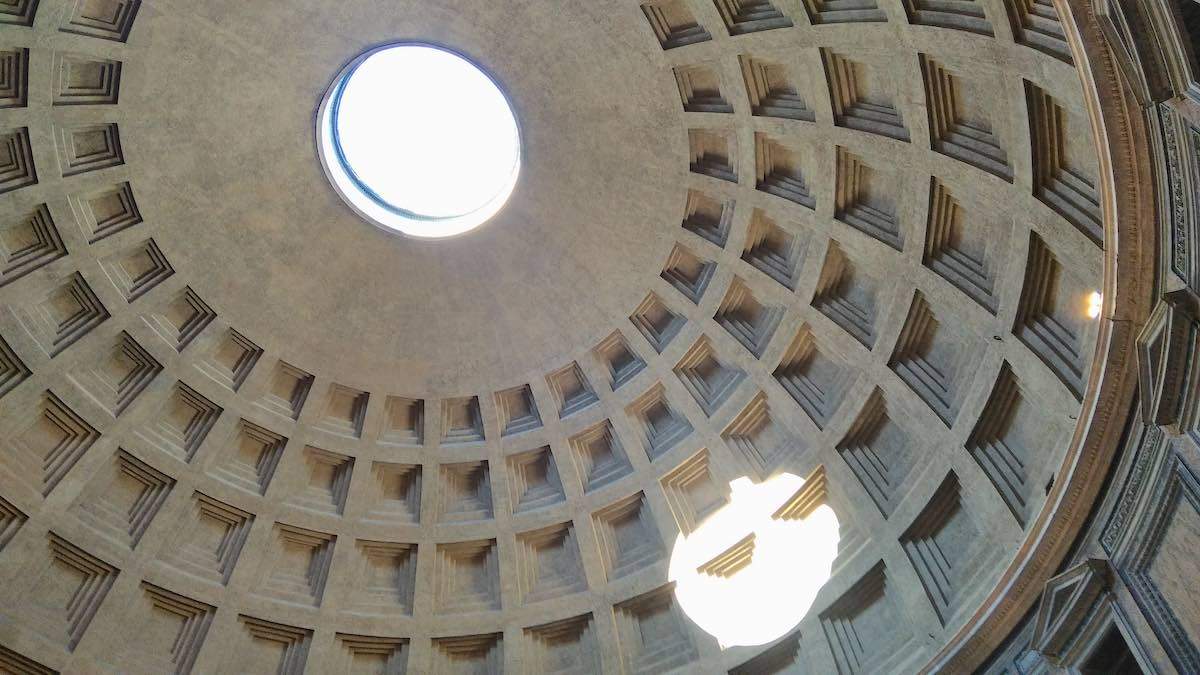
This is the historical landmark most dear to the inhabitants of Rome. The Pantheon we see today dates back to 120 AD under the reign of Emperor Hadrian, but is built on the ruins of a temple at least 150 years earlier.
The pronaos is a rectangular portico with 18 granite columns that solemnly introduces the only main room that is perfectly spherical. The uniqueness of this building is emphasized by the large dome, second in Italy only to that of the Cathedral of Santa Maria del Fiore in Florence. The engineering at the base of the dome has made the building famous throughout the world. At the top, there is an opening called “oculus“, the only window in the room. The weight of the great dome decorated with a coffered ceiling discharges on the walls of the building and can be supported thanks to the fact that it was designed as a mold and filled with successive castings of different materials (travertine, tuff, pumice), from the heaviest to the lightest from bottom to top.
Inside the temple, which became a Christian church in the 7th century A.D. with the name of S. Maria ad Martyres, illustrious personages such as the painter Raffaello Sanzio and the kings of Italy Vittorio Emanuele II and Umberto I are buried.
TIP:
If you haven’t had ice cream in Piazza Navona and regret it, head straight to the nearby Gelateria Buccianti.
TIME FOR DINNER!
The itinerary through the piazzas and monuments for your first day in Rome is over, now you just have to decide what to do with your evening. Do you still have energy to dedicate to the city?
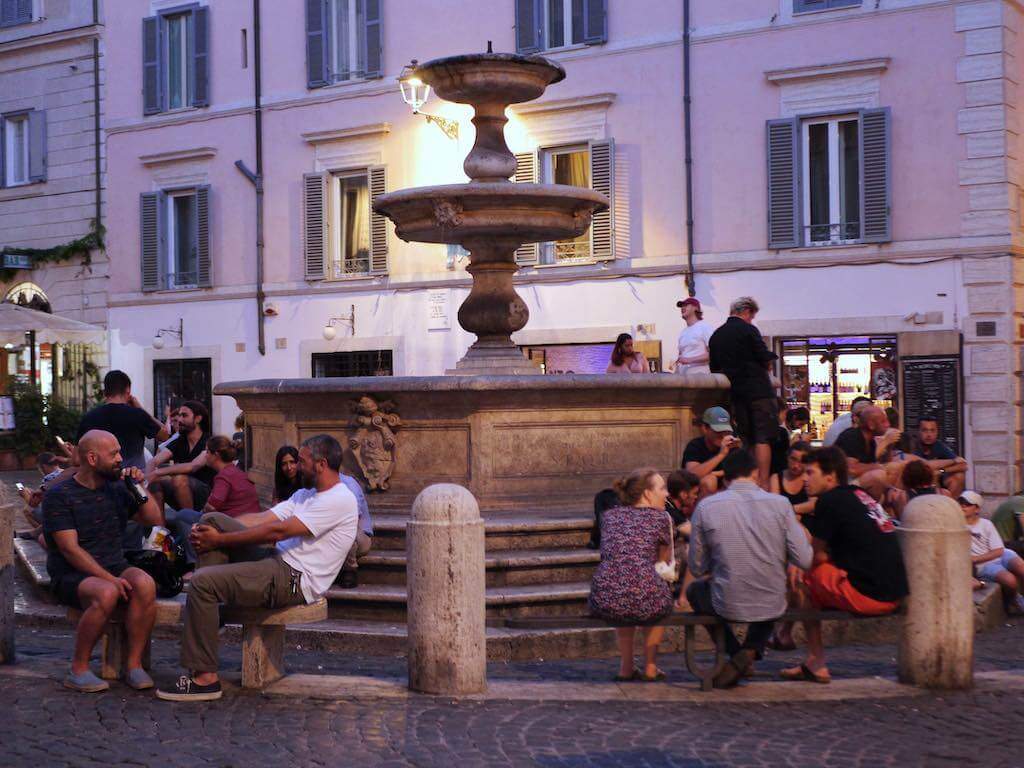
My advice for tonight is to dine in one of two lively and picturesque evening neighborhoods, one is Trastevere, the other is Monti. The choice is yours! Consider that you can devote yourself to the other neighborhood in the second evening of your two days in Rome! Trastevere is one of the most famous neighborhoods of Rome, especially popular with tourists, close to the river Tiber and the picturesque and pedestrian Ponte Sisto that crosses it. Monti, on the other hand, is more off-the-beaten-path, popular especially with locals, more intimate, a stone’s throw from the Colosseum.
Have dinner it in the Trastevere neighborhood?
If you decide to go to Trastevere, I suggest you eat either at Ferrara, a modern restaurant with an extensive wine list and a sophisticated look, close to one of the liveliest squares of the neighborhood, Piazza Trilussa, or at the more typical and homemade Osteria Nannarella. Remember to book your table in advance!
Have dinner it in the Monti neighborhood?
If you decide to spend the evening at Rione Monti, you could dine at the Osteria La Mucca Biricchina, or at the bistro born inside a store of aromatic plants and seeds and that also offers vegan and vegetarian dishes “Aromaticus“. If you love gelato and feel like making a second round for your first day in Rome, try the ice cream made only with raw ingredients from “Grezzo“, it’s really special. For traditional gelato but with a wide choice of non-traditional flavors too, go to “Fatamorgana Monti” in the small and picturesque “Piazza degli Zingari“.
DAY 2 – LAST DAY OF YOUR TWO DAYS ITINERARY IN ROME
And now for the second part of your 2-day in Rome itinerary.
In the morning, we will explore another part of the heart of the historic center, while in the afternoon we may move to the other side of the Tiber.
Leg 1: Trevi Fountain
The fountain that made the rounds of the world thanks to the 1960s film “La Dolce Vita” is one of the most crowded monuments in Rome and its fame is preceded only by that of the Colosseum. If you want to take pictures of yourself with the Trevi Fountain behind you, come here very early in the morning.
The fountain’s current appearance dates back to the 18th century, but of course, its history is much older. It was here that the water flowed out for 20 km from the Aqua Virgo aqueduct, an exceptional hydraulic work undertaken in 19 BC by the right-hand man of Emperor Augustus, Marcus Vipsanius Agrippa. At the time of Agrippa, there were only simple tanks to collect water.
Since the Renaissance, the popes began to invest large sums of money to give the fountain a monumental appearance. The works were completed only in 1762 and involved many architects and artists, including Bernini, Nicola Salvi, Giuseppe Pannini, and Pietro Bracci. The sculptural group, which occupies one side of the Palazzo Poli, represents the god Ocean advancing into the sea through the rocks, accompanied by two horses, one calm (representing the placid aspect of the sea) and one agitated. On either side of the central niche are two smaller ones that house statues representing the characteristics of the water that flows from the fountain: Salubrity and Abundance.
TIP: even if you really want ice cream, don’t stop and buy it right in front of the fountain, where all the tourists who have just arrived in Rome buy it, the city is full of amazing gelato shops.
TIP 2: read my article that encompasses many interesting facts about the Trevi Fountain.
Leg 2: Piazza di Spagna-Spanish Steps
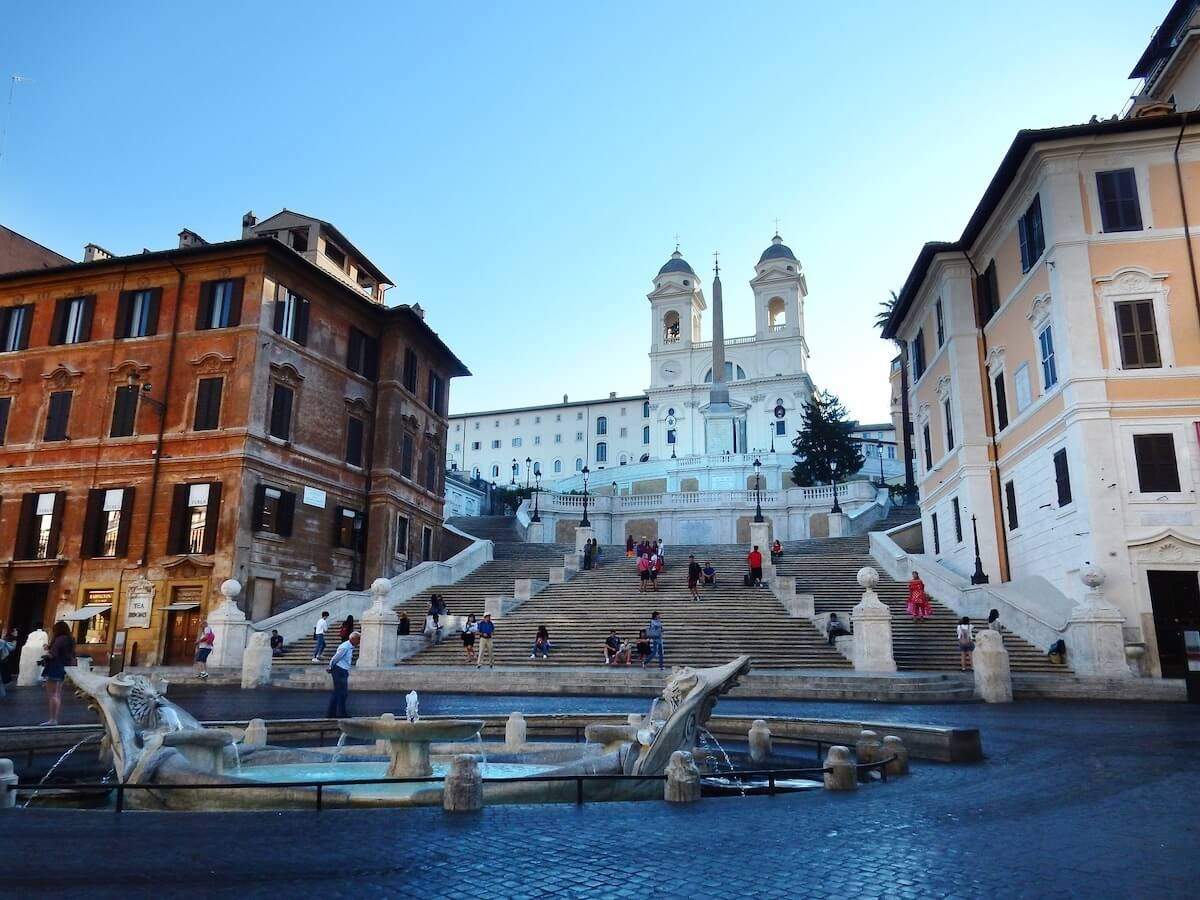
After enjoying the view of Rome’s most famous fountain, walk for 10 minutes to reach another of Rome’s most beautiful squares, Piazza di Spagna. The square was anciently the point where the horses that brought foreigners to the city stopped, after entering through the People’s Gate in Piazza del Popolo. The name of the square comes from the presence of the Spanish Embassy to the Holy See.
Your gaze will be attracted by the sight of the “Barcaccia“, the boat-shaped fountain that seems to sink into the ground, by the grand staircase that elegantly makes its way upwards, and by the Church of Trinità dei Monti, with its Gothic-style facade, in a dominant position at the top of the staircase. It’s worth spending a few minutes observing this spectacular architecture: the fountain was sculpted by Bernini father and son, the church was built on the ruins of a Roman villa when the king of France bought the land (16th century) and the staircase is a project by Francesco de Sanctis (18th century).
The square is also overlooked by Rome’s oldest tea room, the Babingtons Tea Room, and the small museum that arose in the apartments where the poet P.B. Shelley spent the last months of his life, the Keats-Shelley Memorial House.
TIME FOR SHOPPING?
If you want to include a shopping stop on your 2-day Rome itinerary, you can do it now. From Piazza di Spagna starts Via Condotti, which is full of boutiques and famous Italian brands. Via Condotti in turn flows into Via del Corso, one of Rome’s shopping arteries.
Leg 3: should you visit the Vatican Museums?
From the Spanish Steps to the Vatican Museums is about a 3km walk.
It seems that visiting the Vatican Museums is at the top of the list for people traveling to Rome. Visiting the Vatican Museums takes about an hour and a half to two hours. Personally, I think that unless you’re dying to see the Sistine Chapel, whose vault houses Michelangelo’s frescoes, you could stay in the heart of Rome’s historic center and visit closer museums, such as:
- Galleria Borghese, which houses Canova’s stunning sculptures.
- The Capitoline Museums, with the largest collection of ancient sculptures in Rome
- The National Etruscan Museum of Villa Giulia, which exhibits artifacts from different parts of central Italy and attributed to the Etruscan population, who inhabited the area many centuries before the Romans.
If you decide to go to the Vatican anyway, you can take the Metro A near the splendid Piazza del Popolo, get off at the Ottaviano stop and walk about 500 meters to the museum entrance.
DINNER TIME
For this two-day itinerary in Rome, I recommend spending the evening at Rione Trastevere or Rione Monti, as I recommended for day 1. Maybe you could visit tonight the place you discarded yesterday.
If you want to eat something close to the Vatican Museums, I recommend Ristorante Dal Toscano on Via Germanico 56.
Unfortunately, this is the end of the 2 day in Rome itinerary that I recommended. I sincerely hope you’ll reconsider and decide to spend at least 3 days in Rome… it’s absolutely worth it!
WHERE TO STAY FOR TWO DAYS IN ROME
In order to undertake in the most efficient way this itinerary full of stops and things to see and eat, it is very important that you choose an accommodation near the beginning of the route. I suggest different types of accommodations near Rione Monti because it is a small neighborhood adjacent to the Colosseum with a pedestrian area and many cafes, street food and restaurants. If you want to do it yourself, look for a room near Via Urbana or Piazza degli Zingari. From here you can reach the Colosseum in 5 minutes on foot!
HOTEL PALAZZO MANFREDI | Luxury hotel with a breakfast terrace overlooking the Colosseum.
RELAIS MONTI | Small Hotel in the heart of Rione Monti
MONTI STAIRWAY TO HEAVEN | Apartments with terrace in the heart of Rione Monti
I CAPOCCI | Small apartments in the Monti district
Let me know what you think about this 2 days in Rome itinerary!